
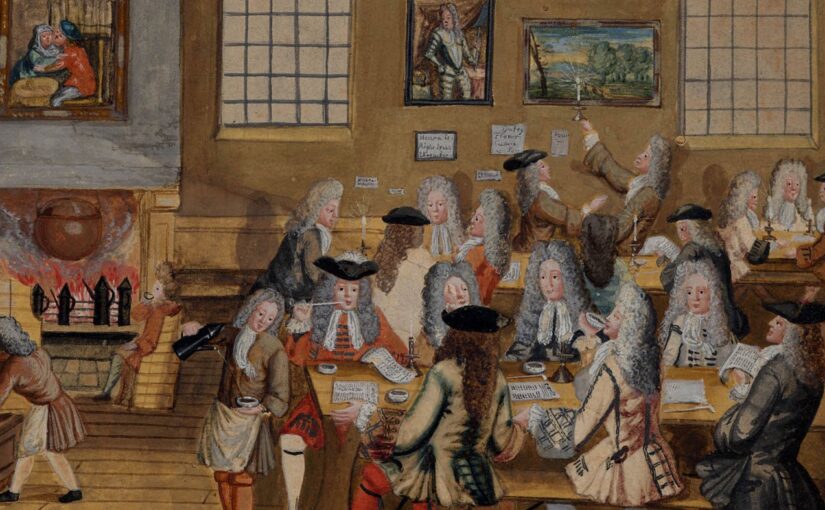
The influence of inns and innkeepers in the expansion of Freemasonry is indisputable. In the early days Masonic lodges commonly met in inns and taverns—venues that offered both practicality and hospitality in an era with few other options. These informal settings provided more than just shelter; they fostered a relaxed and sociable atmosphere, free from the constraints of long travel at a time when motorcars did not yet exist. Before the establishment of the Provincial Grand Lodge of Middlesex, several of the first Lodges in the area convened in such places. The following list is by courtesy of WBro Stan Marut, and it shows the first lodges established in the Middlesex area – even before the Provincial Grand Lodge – which met in taverns.
| LODGE No | NAME | CONSECRATED | FIRST MEETING PLACE |
| 72 | Royal Jubelee | 1810 | Golden Lion, Goodman’s Fields* |
| 255 | Lodge of Harmony | 1785 | Toy Inn, Hampton Court |
| 382 | Royal Union Lodge | 1825 | King’s Arms Inn, Uxbridge |
| 778 | Bard of Avon | 1859 | Golden Lion Hote, Stratford-upon-Aven, later moving to Middlesex |
| 788 | Crescent | 1859 | King’s Head Hotel, Eel Pie Island, Twickenham |
| 858 | South Middlesex | 1861 | Beaufort Hotel, North End, Fulham |
* Goodman’s Fields was essentially outside of the City walls in what is now E1. In 1810 it would have been in Middlesex. Perhaps the first Middlesex Lodge in that area? Many others met in what we might call West/South West Middlesex. Indeed, there is perhaps a whole other history to be written about these early meeting places.
Now read on.
IN THE BEGINNING
Taverns, lnns and Coffee Houses played a meaningful role in the expansion of Freemasonry on the British Isles. The first Grand Lodge of England of speculative Freemasons was itself established at a tavern called The Goose and Gridiron, St Paul’s Churchyard, London. It was June 1717 and over the next six decades the Grand Lodge went on to meet at similar establishments in and around London. Only in 1775, the original Freemasons’ Hall was erected in Great Queen Street, London.
ln medieval time, there was a Free Mason’s Arms inn about every 16 to 20 miles on England’s highways, where operative Freemasons traveled in search of employment. In his diary entry for 1644, Samuel Pepys observed that Freemasons gathered solely in unique inns during their breaks from labour. They were required by regulations to stay in venues that were deemed honest and where only civil company was present. The Fraternity’s Arms were often painted on a sign board installed above the establishment’s porch-way and served to identify such places.
The landlord of every recognized Free Mason’s Arms inn was sworn in as a Serving Brother—continues Pepys — before being allowed to enter the lodge. His wife was sworn in as a “Mason’s Dame” so that if necessary she could work as a waitress and her conduct was explicitly stipulated for in her “oath.”
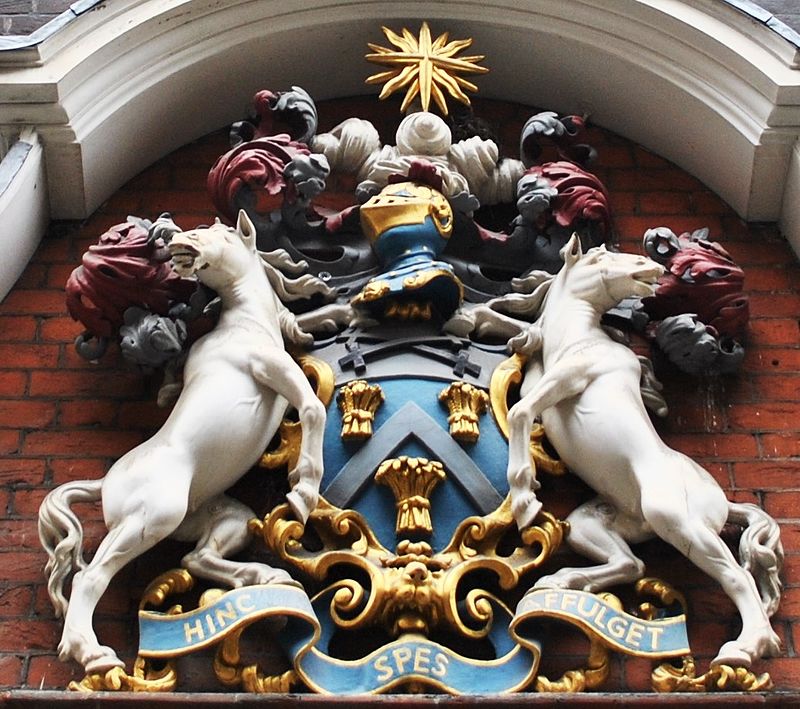
ln his diary, Samuel Pepy’s was, of course, referring to Freemason who were “operative” and belonged to their exclusive trade corporation called a Guild or Livery if based in the Square Mile i.e., the City of London. The Worshipful Company of lnnholders or Hostelers was established under Royal Charter in 1514. ln the City of London both operative and speculative masons met at the Masons’ Hall, a property today demolished but which once stood on Masons’s Lane, off Basinghall Street, near the Guildhall.
After the 1666 Great Fire of London savaged the City, whose buildings were mainly made of timber, an extensive restoration program began under the leadership of Christopher Wren. A year earlier in 1665, the plague had ravaged the country, leading to the deaths of many local Freemasons. Those vacancies were filled by craftsmen from other cities as well as from abroad; but on completion of the rebuilding of London, they moved back out of the capital, driving Freemasonry to turn into a “speculative” Order for survival.
FROM OPERATIVE TO SPECULATIVE
By doing away with the stringent condition that members should be practising a trade, speculative Freemasonry began recruiting from the ranks of the army and navy, accepting rich merchants and even aristocrats who, by often attaining remarkable things for the Order, overshadowed the role played by the taverns’ landlords. Yet, historical records reveal that their profession was the commonest in Lodges during the 18th century.
Inns provided lodging for the exhausted travelers, wholesome food and a protected enclosure for their horse, whereas taverns were more similar to alehouses and were primarily designed to serve alcohol. They were described as “places for the busy man’s enjoyment and the idle man’s business.”
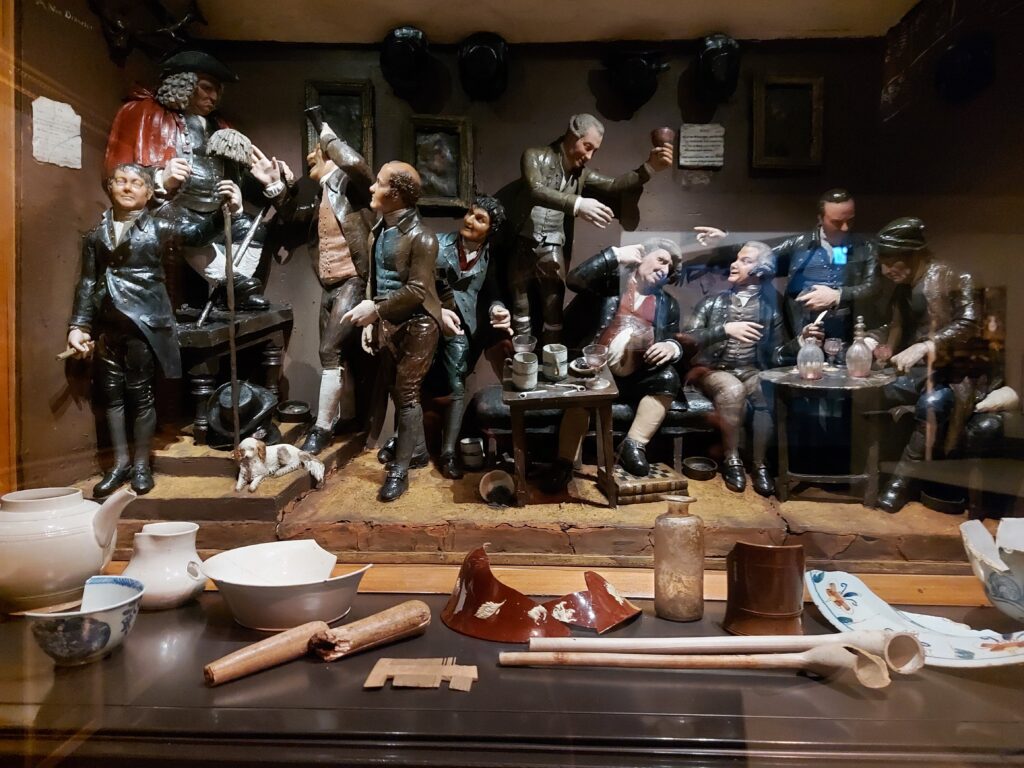
Taverns were modest venues with a wooden floor and uncomfortable stools or chairs, where people gathered to exchange gossip, scandals, contracts and money. The substantial meals were served from noon until late at night, and the landlord would frequently provide complimentary long clay pipes and tobacco, as well as a chamber pot, for the personal relief of the guests.
Coffee houses, which were more common in London than Taverns, offered greater amenities such private rooms and influenced Masonic lodges to eventually move from other locations into these more fashionable enterprises. The Taverns and Coffee Houses of the eighteenth century functioned also as business centres. One would find British insurers meeting at Lloyd’s, auctioneers gathering at Garraway’s, stockbrokers at Jonathan’s, traders at the Baltic’s in Threadneedle Street in the City of London.
Many other societies and private clubs also gathered at taverns and the demand for private accommodation became acute as to lead to a flood of new coffee houses across England. Their prosperity sustained the increase of Masonic lodges in a mutually beneficial relationship.
The most famous coffee house in Georgian London was Tom King’s in Covent Garden Square, which our Brother William Hogarth sketched as a kind of shed on the East wall of St Paul’s Church on the plate titled “Morning”. Tom King’s was a rowdy venue open until the early hours of the morning, where hats could be seen flying, swords would be unsheathed, and blows delivered.
A work by William Hogarth the artist that contains Masonic connotations is “Night”. The print illustrates a Tavern on the right of the picture, thought to be The Rummer and Grapes in Channel Row, Westminster, which at the time was considered to be in Middlesex.
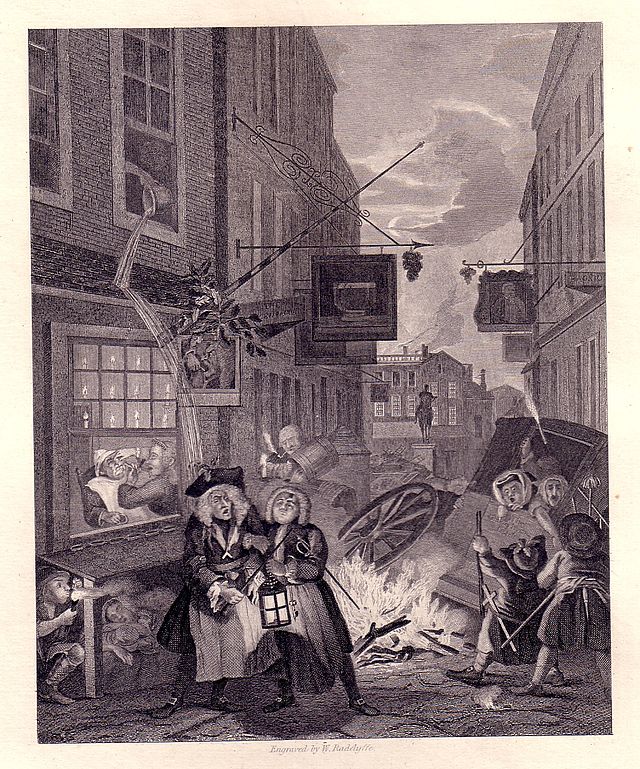
The Rummer and Grapes lnn hosted the Horne Lodge No.4, which between 1723 and 1725 enlisted as a member, the author of the Masonic Constitutions in 1723, Dr James Anderson. Another famous inn was the Toy at Hampton, which boasted an association with Thomas Dunckerley, the founder in 1769 of the Order of Mark Masonry as well as being the place where Alexander Pope wrote “The Rape of the Lock“. Dunckerley was a prolific Freemason who became the Provincial Grand Master of nine Provinces and the Provincial Grand Superintendent of eighteen Royal Arch Provinces. By claiming to be a ‘natural’ son of King George ll, he received ‘grace and favour’ apartments at Hampton Court Palace and on 2nd June 1785, he established at the Toy lnn the Lodge of Harmony No.255, which presently meets at the Twickenham Masonic Centre, Cole Court.
THE LABOURS OF THE DAY
The following is an account of an 18th century Masonic meeting held in a tavern:
“When assembled, the brethren, properly dressed, sat down around a table on which were candelabra, and also three separate candles, placed in a triangle, to light the proceedings, as well as the large bowl of punch for refreshment. Clay pipes were lit up and, as the evening progressed,snacks were demanded and delivered by the doorkeeper. On completion of any business, such as the making of a mason or the election of officers, toasts were offered and drunk on the spot; songs, usually Masonic but occasionally bawdy, were sung. The newly initiated brother washed off the ‘tracing board’, contributions to the lodge benevolent fund were made, the bill for the evening’s refreshment settled with the landlord and gratuities made to the doorkeeper. Most of the brethren then went home (..) The Master held sway and always wore his hat — the only member to do so; like the gavel it invested him with power and authority.“
THE INNKEEPER
In general, innkeepers were regarded “men of honour” and as such, many of them covered also the office of either Major of their village or judge in their local community. lnnkeepers were portrayed as “men of bold speech, wise, and merry.” Many of them were former soldiers, but there were others who entered the trade inspired by nobler intentions, like in the case of the father of the artist and Freemason William Hogarth. Richard Hogarth was a classicist who wrote many Latin and Greek textbooks. To give students a chance to practice their conversational skills, he opened a Coffee Shop in St John’s Gate, near Smithfield, in 1703 and introduced the rule that all patrons should speak in Latin at all times. The shop struggled and closed its doors in 1707, with Richard ending up spending five years in the Fleet Prison.
In the AQC Transaction vol.101, 1988, page 213, Bro Christopher Gotch describes the service Freemasons received from an innkeeper.
“Apart from delivering the summons, the establishment proprietor had to store the lodge furniture such as the minute books, jewels, working tools, candelabra. He stored all the aprons and provided new ones, too. From where he obtained them is uncertain (…) The innkeeper was also expected to collect the fees from the Initiates as well as fines imposed on misbehaving brethren.“
Unsurprisingly, few landlords ever reached the Chair, expected as they were to act as Secretary, Treasurer, Tyler and Steward of a Lodge.
The following is an amusing anecdote that Bro. Goldsmith presented in his 1987 Prestonian lecture titled “The Role of the Innkeeper in Masonry” and published in the ACQ Transaction vol.101,1988. lt concerns the Landlord of the Coach & Horses Inn at lspwich, and a member of the British Union Lodge No.114, who, on being committed to Marshalsea Prison in 1821, wrote to his Worshipful Master pleading for help. The reply was:
“lf Masonry has taught you that to assist our distressed Brethren is an essential duty, it ought also to instruct you that to render its charity efficiently, it selects for its objects the Moral and Good, and that it rejects from a participation in its Benevolence, the dissolute and the vicious.“
Rule No. 117 of the Masonic Constitutions of 1723, states that a Lodge must hold its meetings at a place sanctioned by its Grand Lodge and that such place must never be an inn of which one of the Lodge’s officers is the proprietor. It reads: “no master of a public house should in future be a member of any lodge holden in his house (….) neither it may be held in a private house“ although in the early days of Freemasonry, many Lodges were so held because of course exceptions could and were granted by Grand Lodge.
The Hotel and Restaurant Managers have taken the place of the affable innkeeper and tavern landlords in contemporary times, but the practice by those fellows of joining a Livery or the Craft — and sometimes both — appears to survive.
We express our gratitude to those very skilled individuals for arranging a service that is paramount to the Brethren’s comfort, entertainment and refreshment, and without which Freemasonry as we know it would not be conceivable.

- Mercury - editorial Team;
- Royal History Society of England ;
- Huguenot Society of GB & Ireland;
- Pinner Local History Society;
- Author of several Masonic articles and of the book:"The Middlesex Pinner Lodge's Pavarotti - Life and Time of Bro Joseph Emile Ceci"
- BROTHERS IN SERVICE - December 3, 2025
- TETRAKTYS’ WEBSITE IS BACK ‘LIVE’ - November 30, 2025
- The influence of inns and innkeepers in the expansion of Freemasonry - August 5, 2025
