
The Solicitor, a Forensic Scientist, and the Shadow of the Ardlamont Murder
In Scottish law, the unique Murder Not Proven verdict exists alongside Guilty and Not Guilty. Dating back to the 18th century, it allows jurors to express that, though they suspect wrongdoing, the evidence falls short of removing reasonable doubts. Jack House, author of the book Murder Not Proven—later adapted for television by the BBC—argued that Victorian trials were not only shaped by evidence, but by respectability. In his view, social standing often protected the accused. The more respectable the defendant was or even looked, the greater the chance of escaping justice. A telling example of this was the 1893 trial known as the Ardlamont Case (12/12/1893 – 22/12/1893), in which Arthur Toovey, a solicitor and Middlesex Freemason, was called to testify.
The Ardlamont Case: Murder or Misadventure?
The trial commenced on 12th December 1893 at the Edinburgh High Court. It centred on the suspicious death of Cecil Hambrough, the simple-minded son of an English aristocrat family weighed down by financial difficulties, who died during a shooting trip at the Ardlamont estate in Argyllshire, Scotland. Hambrough, in his early twenties, was accompanied by his tutor, the 33 years old Alfred John Monson, and a man introduced as Edward Scott who was later unmasked as a career criminal.
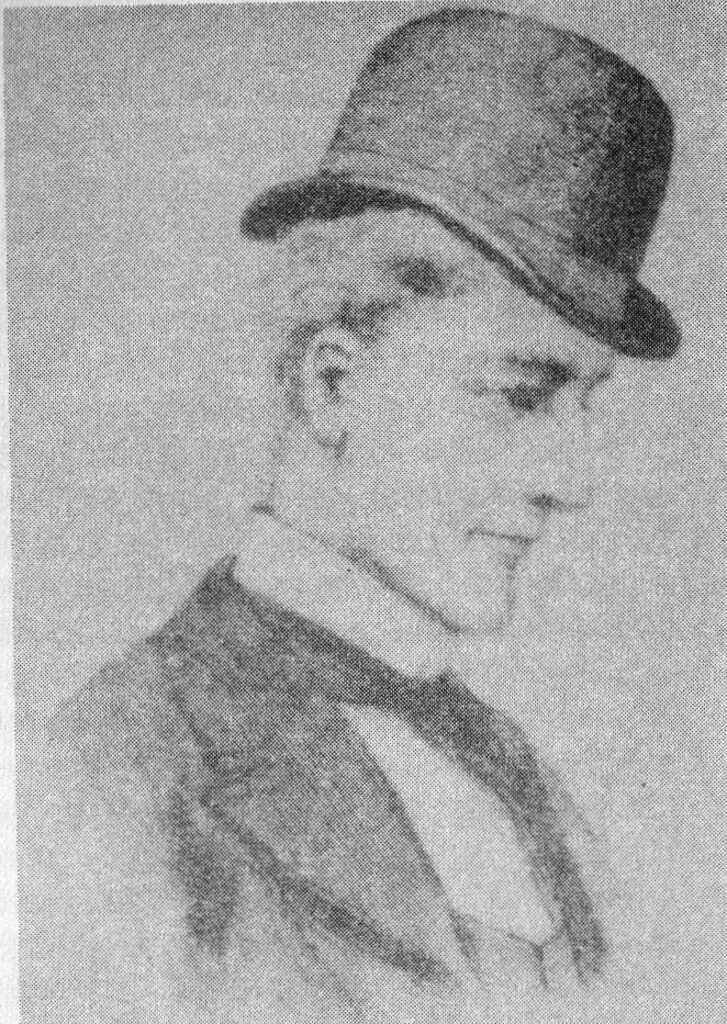
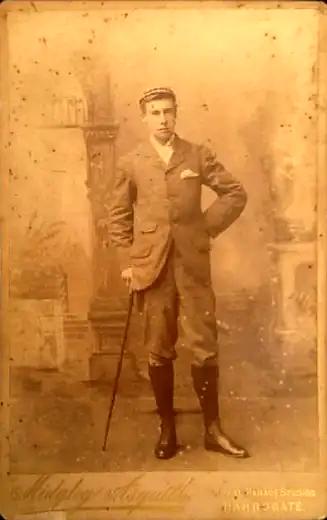
Alfred John Monson (left) – Photo from Murder Not Proven by Jack House and Cecil Hambrough (right) – Photo courtesy of the Worcester College
Just two days before he left for Ardlamont, Monson had secured a £20,000 life insurance policy on Hambrough’s life—naming himself the sole beneficiary and funding the initial premium by drawing on other fully assigned policies. It was a sophisticated confidence trick.
On August 10th, Hambrough was found shot in the back of the head while out game shooting with Monson and Scott—just a day after the duo’s attempt to drown him in the estate’s lake had miserably failed.
Monson claimed the rifle the young man was carrying had discharged accidentally as he was attempting to climb a fence. But suspicion mounted rapidly when Monson’s dubious past, and his questionable financial deals came to light.
The case presented a classic situation: a motive, no eyewitnesses, circumstantial evidence, but no incontrovertible proof. Ultimately, Monson was acquitted—with the jury returning a verdict of Not Proven.
The Testimony of Brother Arthur Toovey
Among those called to give evidence at the trial was Arthur Toovey (11 December 1852 – 6 April 1915), a well-regarded solicitor based at 18 Orchard Street, Marylebone, London. In 1890, he had taken up residence at Mount Cottage, Pinner, shortly after the Metropolitan Railway had been extended from Baker Street—just a stone’s throw from Marylebone—making commuting from places on the outskirt of London, both practical and convenient.
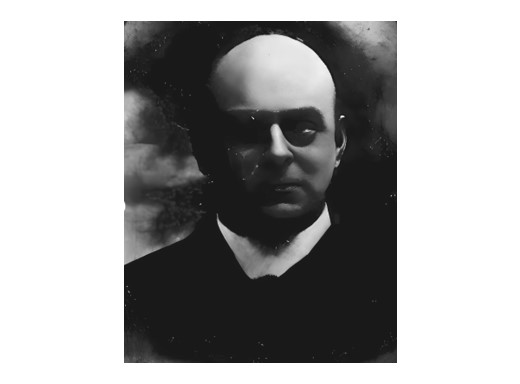
Photo of A. Toovey from the Uxbridge & W. Drayton Gazette of Friday, 16 April 1915
In Pinner, Toovey quickly emerged as a force for change and in 1894, he led a successful campaign to preserve its rural status, fending off a proposal to place Pinner under urban powers. As a mark of merit, the following year he was elected Councillor and Vice-Chairman of the newly independent Parish.
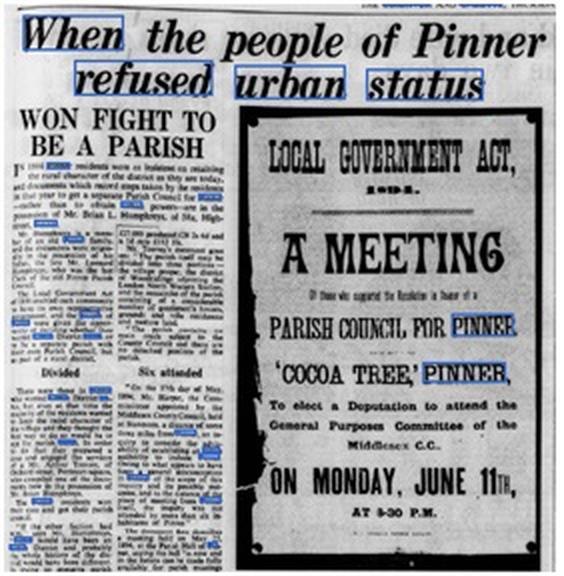
Harrow Observer – Thursday, 24 January 1963
Toovey’s testimony was heard on the seventh day of the trial. His role was to help unravel the complex financial dealings that supported Monson’s extravagant lifestyle.
According to The Dundee Advertiser (19th December 1893), the clean-shaven and composed Toovey spoke eloquently and with confidence. He told the Court that, in 1892, he had been instructed by the York City & County Bank to recover a £700 overdraft owed by Monson.
Having obtained judgment, Toovey seized Monson’s assets and auctioned them. But when cross-examined about how much money he had recovered, Toovey replied with his characteristic dry wit and a smile :
“You would not make much of that judgment,” he said—explaining that after deducting the Bailiff’s fees of £10 from the £25 raised, only £14 were returned to the bank—a mere 2% of the original debt. “That is all you got out of it?” asked the examiner. “Yes,” replied Arthur, prompting laughter from the courtroom.
Even more startling and striking was Toovey’s disclosure that in December 1892, he had been engaged by a country law firm, to obtain judgement on behalf of Mrs Monson against Cecil Hambrough for £800. The sum had allegedly been spent to cover Cecil Hambrough’s expenses for lodging, tuition, clothing, and securing a commission in the army. In reality, and as part of the plot to get full control over the young man through blackmail, Mrs Monson had entered into a physical relationship with him and had lavished the money in the manner of a smitten lover indulging her companion. There was no realistic prospect of ever recovering it.
When questioned, Toovey admitted he had neither been informed of the true nature of the arrangement, nor had he, somewhat naively, suspected it.
Beyond running a London legal practise that focused primarily in property auctions, land sales and inheritance matters, Cllr Toovey actively served the community of Pinner for 31 years. He was a trustee of many charities, and an outspoken opponent of selling public land to developers and speculators.
His advocacy contributed to the passing of the Metropolitan Commons (Harrow Weald) Supplemental Act 1899, which guaranteed that open spaces would remain under public stewardship. He also was instrumental in the establishment of the Pinner Lawn Tennis Club, West End Lane, on land leased by the Metropolitan Railway to the Council for recreational use, in return for an exemption from maintenance costs and taxes.
Toovey’s dedication to public service was matched by his deep respect for democratic principles and due process. In his early years as a councillor, he supported Pinner’s pursuit of rural status and during the prolonged debate over the cost and need for street lighting, he was strongly convinced that such decisions should rest with the local residents. Ultimately, however, he set aside his earlier convictions and supported the move to secure urban powers for Pinner—recognising that, particularly in the matter of street lighting, this was the most effective way to serve the community’s interests and enable traditionally conservative Pinner to keep pace with the changing times.
Arthur was also deeply involved in fraternal organizations. A long-standing treasurer of the Pinner British Queen Lodge of Oddfellows No. 3861 , he was initiated in 1885 in the Masonic Alexandra Palace lodge no. 1541, which met at the Viaduct Hotel in Holborn. In 1910, he established Pinner’s leading Masonic lodge No. 3423, serving as its Treasurer and remaining an active and dedicated member until his death in 1915.
Driven by a passion for nature and agriculture, Toovey was Secretary of Pinner Horticultural Society. He served as Chairman of the Pinner Parish Council, was a Freeman of the City of London, and governor on the board of the Aldenham School, Aldenham, Herts — where he studied as a child.
Toovey was a man who collected titles, certainly—but when he died at the age of 63, he left behind a good record of work diligently done. When he died, the Harrow Observer remembered him not merely for his many roles, but for his character, describing him on Friday 16th April 1915, as a man with a sharp sense of humour, a fair and compassionate nature, the warmth of a genial companion, and, above all, the character of a true gentleman.
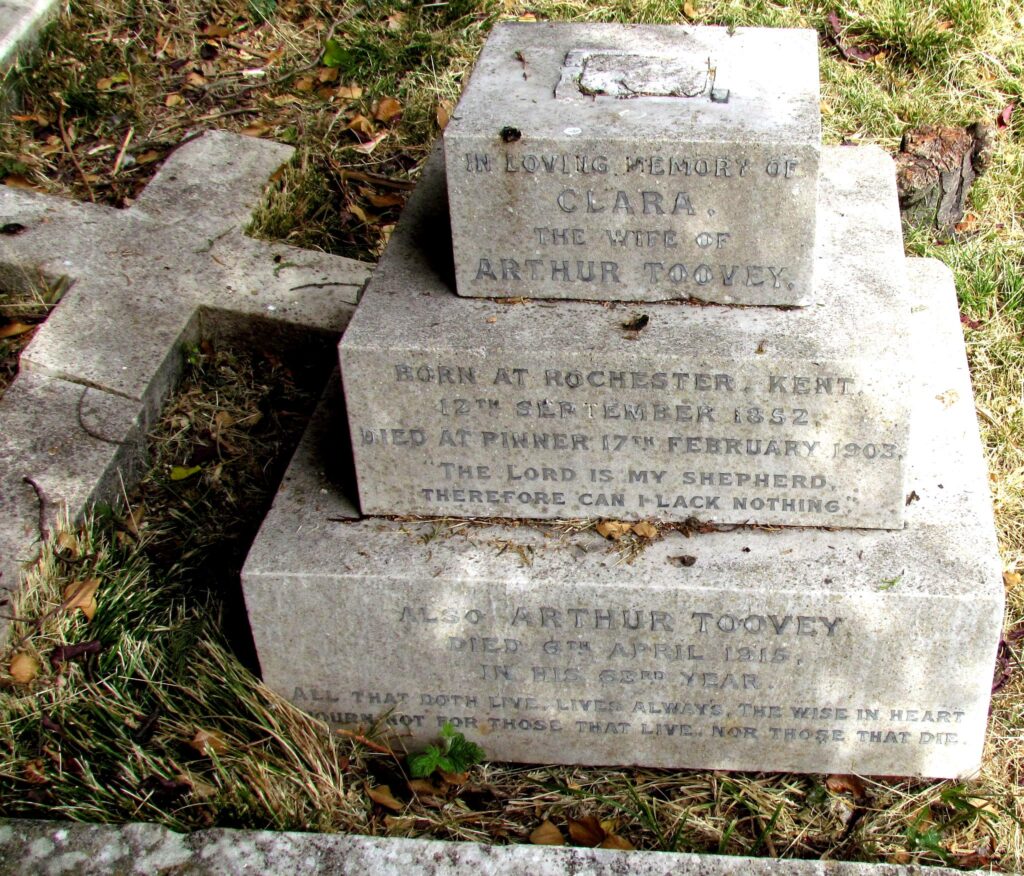
Photo taken by the author
His resting place lies in Pinner Old Cemetery on Paines Lane, Pinner, where his family grave is still well tended today.
Forensic That Came Too Late
Had the Ardlamont trial taken place a quarter-century later, its outcome might well have been different. For by then, British forensic science had undergone a revolution —thanks largely to Dr. Bernard Henry Spilsbury, a pathologist whose reputation came to rival that of a famous fictional detective.
As a lecturer and a pathologist at various London Hospitals and for the Police, his work required frequent relocation, and census show a string of different addresses against his name. He is reported, however, to have lived on Hindes Road in Harrow-on-the-Hill in 1906, and at St John’s Wood in 1912. Like Toovey, therefore, Spilsbury had ties with Middlesex.
In 1920, he was initiated into the Craft lodge Rahere No. 2546, becoming its worshipful master in 1932. In 1922, Spilsbury joined the Mark Mason lodge Abernethy No. 722, serving as its master in 1933 and the lodge Sancta Maria (or Saint Mary) No. 2682, both lodges respectfully affiliated with the medical schools of St Mary’s and St Bart’s hospitals.
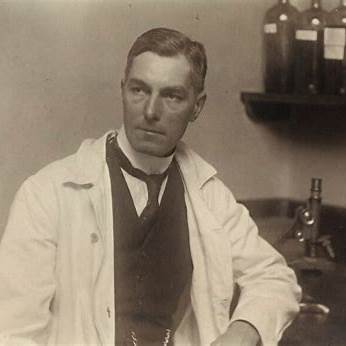
Bernard Henry Spilsbury (16 May 1877- 17 December 1947) – Official portrait in his lab at the St Mary’s Hospital (c.1925)
Born in Leamington Spa and graduated at Oxford University, Spilsbury’s forensic career began in 1908 as chief pathologist at St Mary’s hospital, London. Just two years later, he helped convict Dr. Crippen in a sensational murder trial and became the Home Office pathologist and the most respected criminal scientist in England. Appalled by the unscientific nature of crime scene investigations, in 1924 Spilsbury invented and introduced to Scotland Yard the murder bag. This was a portable forensic kit filled with gloves, tweezers, vials, and containers which later became standard issue for detectives, enabling proper collection of uncontaminated evidence.
Bernard Spilsbury’s work elevated forensic pathology to a respected science and was a game changer for modern criminology.
Though it was a Dr. Joseph Bell who inspired Bro. Arthur Conan Doyle’s Sherlock Holmes, Spilsbury embodied the role of that character in real life. His courtroom testimony carried enormous influence and had he investigated the Ardlamont case, his meticulous approach may well have shifted the balance from suspicion to conviction.
A Life of Service, Discipline and Tragedy
Standing over six feet tall, Spilsbury cut an imposing figure—always impeccably dressed in top hat, spats, and in line with Masonic decorum, dark jacket and grey striped trousers. He became a media darling. But behind the polished image laid personal anguish. He struggled with chronic back pain and depended heavily on tobacco and painkillers to manage his daily discomfort. The loss of his two sons—one killed by a German bomb, the other succumbing to tuberculosis—deeply affected him. In addition, he suffered two mild strokes, and the mounting envy and criticism from professional peers further wore him down, both physically and emotionally.
On 17 December 1947, Spilsbury was found dead in his laboratory at St Mary’s Hospital. A gas burner left running at the scene strongly suggested that his death was the result of suicide.
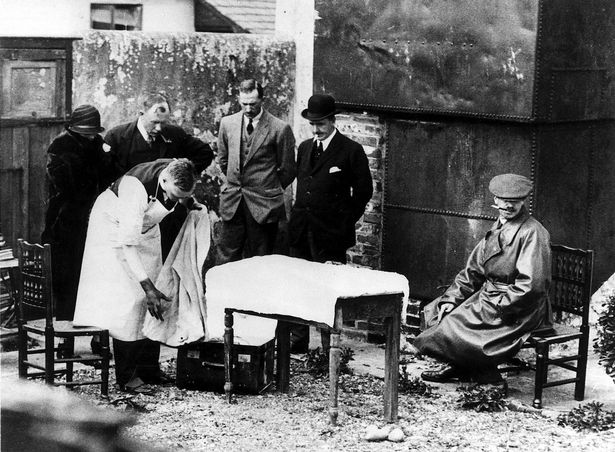
Early 19th century crime scene reconstruction
Legacies Etched in Service
Spilsbury was knighted in 1923, but like Arthur Toovey, he was never elevated to the highest offices within Freemasonry. Both men, however, left a lasting legacy. Toovey dedicated his life to charity, law, and championed public service; Spilsbury transformed the science of criminal investigation.
Their stories are a reminder that the measure of a person’s life lies not in titles but in the impact on people that he leaves behind through a mark of love, work, integrity, justice and compassion. That, in my view, is the highest calling of all and the only service to the Great Architect of the Universe that is well worth remembering a man for.
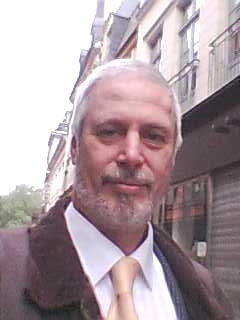
- Mercury - editorial Team;
- Royal History Society of England ;
- Huguenot Society of GB & Ireland;
- Pinner Local History Society;
- Author of several Masonic articles and of the book:"The Middlesex Pinner Lodge's Pavarotti - Life and Time of Bro Joseph Emile Ceci"
- BROTHERS IN SERVICE - December 3, 2025
- TETRAKTYS’ WEBSITE IS BACK ‘LIVE’ - November 30, 2025
- The influence of inns and innkeepers in the expansion of Freemasonry - August 5, 2025
